My Journey Building a Quadruped
First Posted: April 5, 2026
Abstract
Ever since transferring into Mechatronics Engineering, I've been exposed to a lot of cool technologies, including 3D printing, ROS2 (see my blog post), and I've been tinkering frequently with my Arduino!
Inspired by my mentor Lokesh Patel, I wanted to make a big project to learn the skills that I might have missed out on in the first year of the program. I also wanted to make something really cool that could teach me about robotics physics, ros2, and mechanical design in one. While this could be a complex project for me to tackle over the 4 months of a co-op term, I'm looking forward to problem solving every day I can!
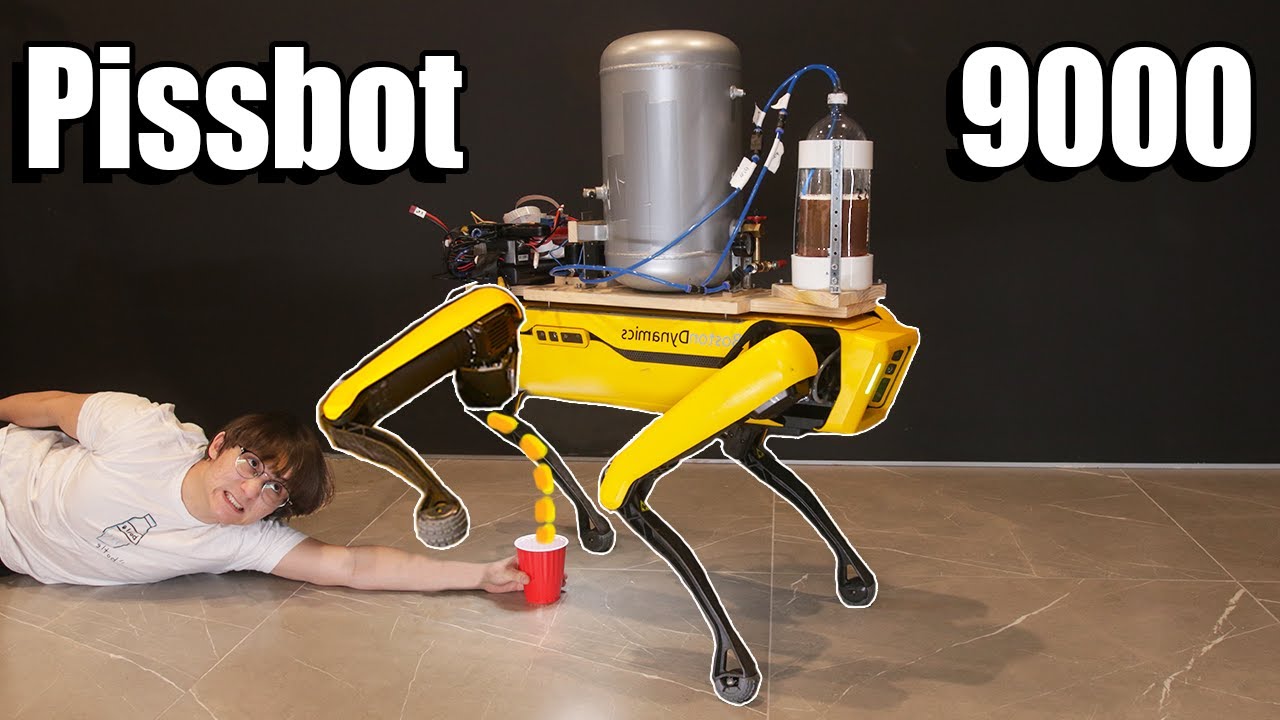
I've always wanted to have a dog, and I fondly remember the first time I watched Michael Reeves' videos featuring Spot, the Quadruped from Boston Dynamics. This inspired me to take a swing at making my own Spot. From now on, it will be referred to as QB, short for Q-Bot, which is once again short for Quadruped Bot. Creative, I know. Maybe one day I will give it a better name. Like Gary. (Shoutout if you get the Robot 4 reference)
Setting out my Roadmap
Today is April 5th, 2026. I got super bored of studying for exams, so instead, I got excited and started planning out a roadmap for how I'm going to tackle this engineering problem. I am still focusing on exams, but I am really excited to get building after exams.
Design Decisions
For the legs, I have decided on 3 DOF. With 4 legs, this means I will need 12 Servo Motors. I'll be using a Bambu Labs P1S for 3D printing all of the robot's parts. The ultimate goal of this project is to allow the robot to navigate indoor spaces and small outdoor spaces with reactive obstacle avoidance and local waypoint movement. This will utilize 2D LiDAR SLAM and a front-facing camera. I admit this is looking pretty far into the future, but it's good to have a final goal in mind. I'll be using PLA for the prototyping prints to figure out the inverse kinematics and forwards/backwards walking protocols, and I'll be using ABS for the final structural parts, because I hear it's better structurally. I don't expect this robot to be massive, like Spot. Rather, I expect it to be around the size of my compact mini-itx PC.
My First 3D Printer
This P1S is also my first 3D printer. While it's definitely not my first time 3D printing, I don't have the expertise of setting up and tuning 3D printers. The Rapid Prototyping Centre (RPC) at the University of Waterloo has been a great resource with loads of P2S and P1S printers. I've gotten to experience the workflow of printing and make some of my own fun projects. In fact, I had so much fun that I wanted to have a new printer! I landed on the P1S for a couple of specific reasons.
Firstly, the cost of the printer is within my budget. I wanted to get a higher quality printer that could last me a while, and also one that had an enclosure, because I read that enclosures can prevent warping on ABS, which is the filament I want to do my structural prints in. They also have better fume control, which is especially good because I mostly work in relatively small spaces, like my room.
Secondly, I've had experience printing on both ELEGOO and Bambu Labs printers, and I can say that Bambu Labs takes ease of setup and the availability of replacement parts to a new level. While this is my first time owning a 3D printer of my own, I've seen friends first-hand who own Bambu Labs printers and can attest to their benefits. Also, Bambu Labs Studio and the slicing, support setup, and everything else is so easy to use!
I didn't want to go for a P2S because it was a bit out of my budget. I can definitely justify $500 CAD for a solid 3D printer, but I am not sure about the marginal benefits of the P2S over the P1S for $300 CAD more. Will update on this later.
Phase 1: Single Leg Prototype
I ended up getting a P2S, and spending some time acquainting myself with the printing function and printer debugging. I've learned a lot about improving print quality and creating my own models. I actually have a course that I have to complete for my engineering design credit, which I have been working on in an effort to understand Solidworks to a greater degree.
To begin my design for the single leg prototype, I focused on freehand sketching the leg first, to give myself a general idea of what needs to be optimized during my design.
Getting a very rough sketch down of the shin helped, and I have attached some preliminary sketches and features from Solidworks.
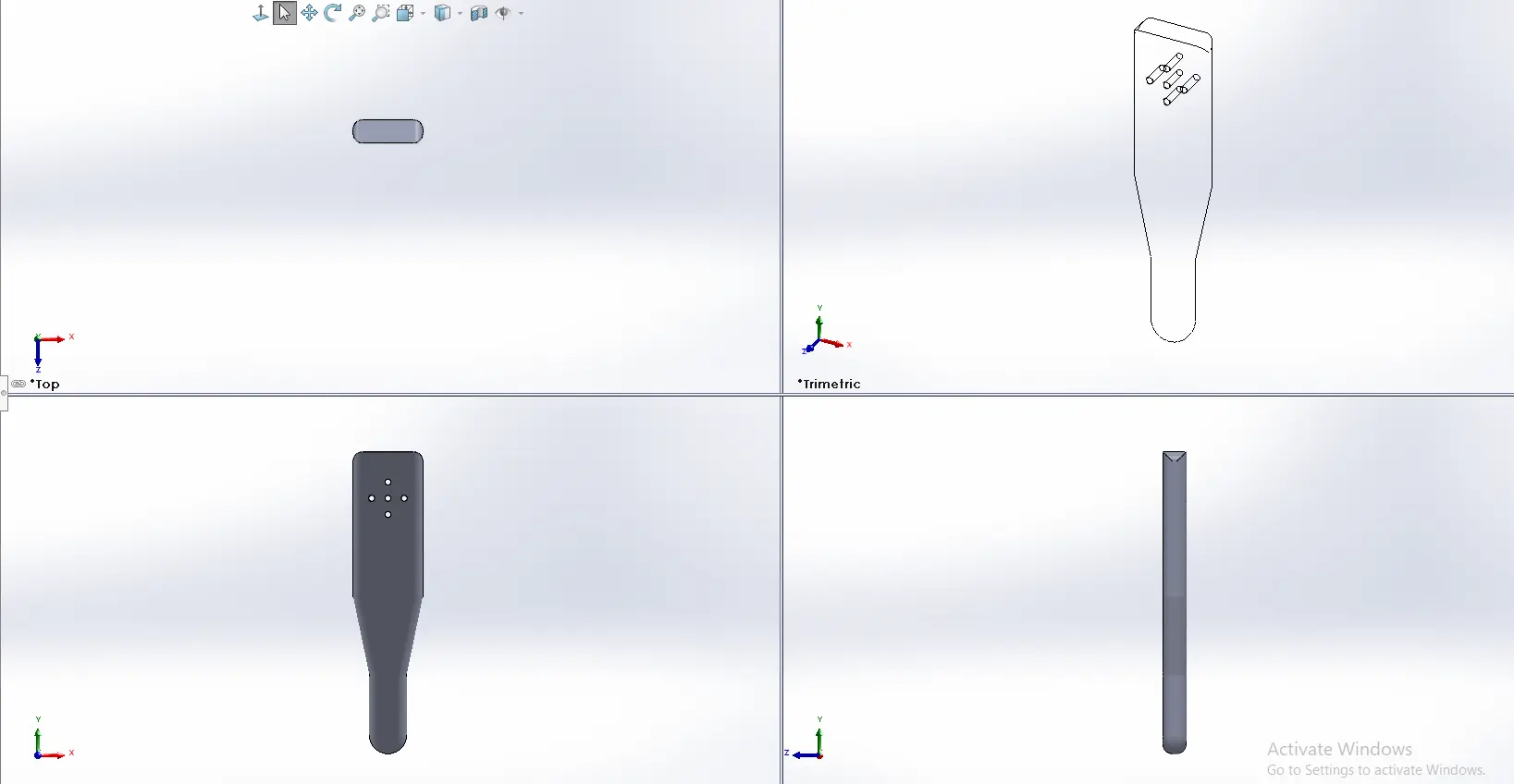
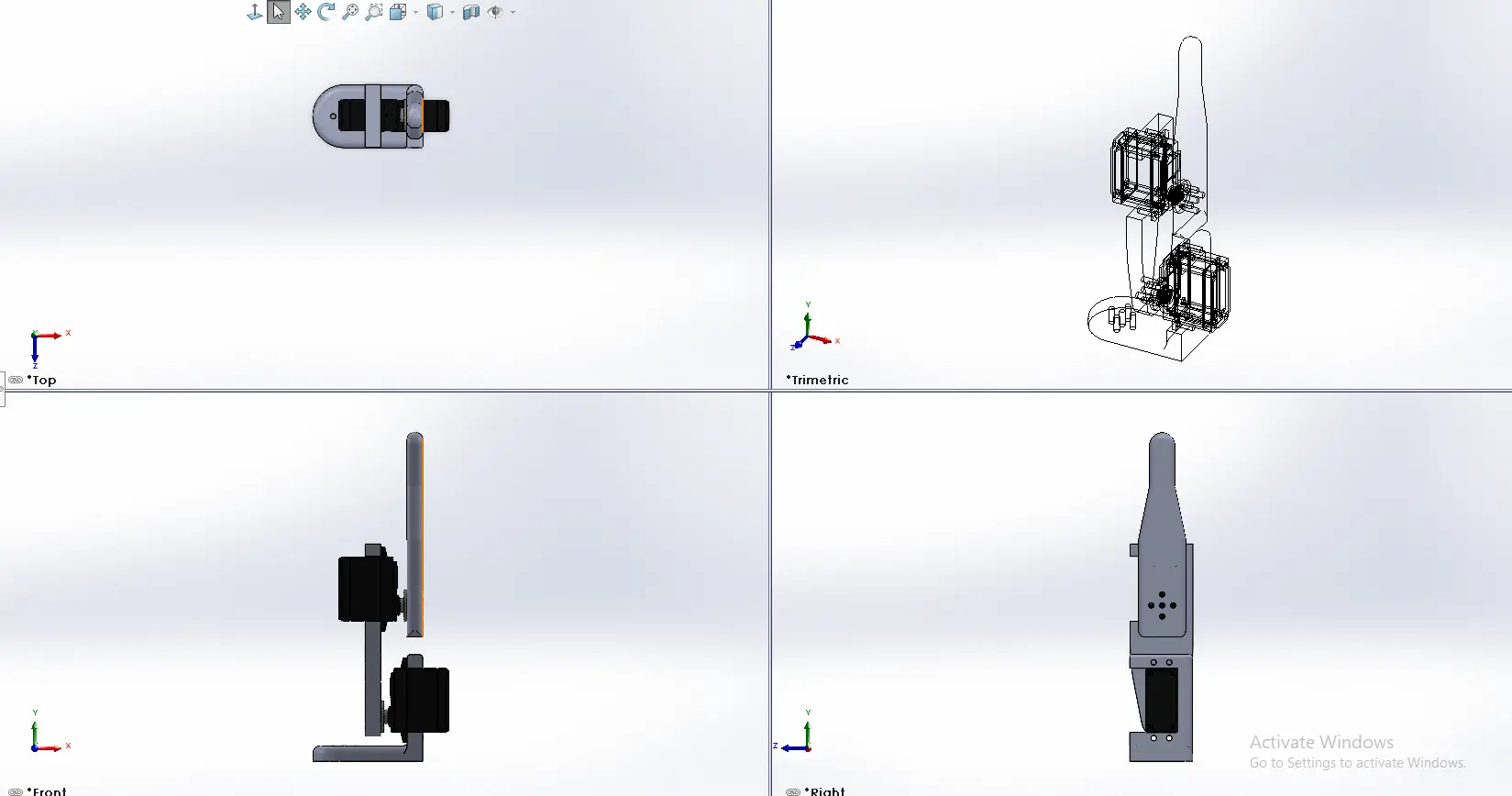
This shin design eventually evolved through 4 iterations, as well as a thigh that went through over 6 iterations and a hip that went through 2, to result in a complete leg. The mechanical design itself is relatively straightforward, but there were many considerations and learning moments that went into the development of each of the parts.
Servo Calibration
Before working on leg kinematics, I calibrated each of the three MG996R servos individually. The leg uses one servo for hip movement, one for the thigh, and one for the knee.
I mounted each servo in its final position, commanded it to its nominal center, and then attached the servo horn as close as possible to the desired mechanical reference position. Any remaining error caused by the discrete spline positions could then be handled with a small software offset.
The calibrated neutral positions for the right leg are:
const float HIP_NEUTRAL   = 97.0;
const float THIGH_NEUTRAL = 86.0;
const float KNEE_NEUTRAL  = 94.0;
During calibration, I also discovered that one of the MG996R servos was defective. It was behaving inconsistently near the limits of its travel and producing a noticeable clicking sound at the end of movements. Replacing that servo resolved the issue.
One useful takeaway from this process was that calibration is much easier when each servo is tested independently before attempting coordinated movement of the entire leg.
Defining Joint Directions
Because of how the servos are mounted, the thigh and knee servos rotate in opposite directions relative to the leg's coordinate system.
For the right leg:
- decreasing the thigh servo command moves the thigh forward;
- increasing the knee servo command moves the shin forward.
Rather than accounting for this throughout the inverse kinematics code, I handle it at the servo-control layer:
const int THIGH_DIRECTION = -1;
const int KNEE_DIRECTION  = 1;
A desired mathematical joint angle is converted to a physical servo command using:
servoAngle = neutral + direction * jointAngle;
This keeps the kinematics independent of how each servo happens to be installed. The IK can use a consistent coordinate system while the low-level servo code handles offsets and reversed joints.
Measuring the Leg Geometry
For the kinematics calculations, I measured the link lengths between joint rotation axes rather than using the overall dimensions of the printed parts.
The current leg dimensions are:
const float THIGH_LENGTH = 7.08;  // cm
const float SHIN_LENGTH  = 11.0;  // cm
THIGH_LENGTH is the distance from the thigh rotation axis to the knee rotation axis, while SHIN_LENGTH is the distance from the knee rotation axis to the foot contact point.
This gives the leg a theoretical maximum extension of:
7.08 cm + 11.00 cm = 18.08 cm
Because the links have unequal lengths, there is also a small region close to the hip that the foot cannot reach.
Single-Leg Inverse Kinematics
With the servos calibrated and the link dimensions measured, I implemented inverse kinematics for the thigh and knee.
For now, I am treating the leg as a planar two-link mechanism and keeping the hip servo fixed at its calibrated neutral position. The desired foot position is described using two coordinates:
+x = forward
+z = downward
For example:
setFootPosition(3.0, 15.0);
requests a foot position 3 cm forward and 15 cm below the thigh joint.
The IK first checks whether the requested point is physically reachable. It then uses the law of cosines to calculate the knee angle and solves for the corresponding thigh angle.
A simplified version of the calculation is:
float distanceSquared = x * x + z * z;
float distance = sqrt(distanceSquared);

float cosKnee =
    (L1 * L1 + L2 * L2 - distanceSquared)
    / (2.0 * L1 * L2);

float internalKnee = acos(cosKnee);

float kneeAngle =
    180.0 - internalKnee * 180.0 / PI;
The resulting mathematical joint angles are then passed through the calibration layer before being sent to the servos.
At this point, the inverse kinematics appears to be working correctly for the single leg. Moving the target foot position produces the expected combination of thigh and knee movement.
Current Control Architecture
The control system is beginning to separate into several layers:
Desired foot position
        ↓
Inverse kinematics
        ↓
Joint angles
        ↓
Servo calibration
        ↓
PWM commands
        ↓
Physical leg
This separation is important because higher-level motion code does not need to know that one servo is reversed or that a particular joint's neutral position is 86° instead of 90°.
The higher-level controller can work entirely in terms of joint angles and foot positions.
Current State
The current prototype can:
- independently control the hip, thigh, and knee MG996R servos;
- account for individual servo neutral positions;
- compensate for opposite servo mounting directions;
- calculate thigh and knee angles for a desired planar foot position;
- reject foot positions outside the physical workspace of the leg.
The next major step will be moving beyond individual static foot positions. I still need to implement smooth interpolation between targets, test controlled foot trajectories, and eventually coordinate all four legs into a gait.
For now, I want to make sure the single-leg kinematics are reliable before introducing the additional complexity of walking.